










News
Latest news
More...
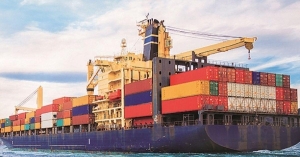
Iran and Russia are mulling to form a shipping firm that could complement INSTC that connects India with Russia via Iran.
Iran’s Ambassador to Russia Kazem Jalali recently stated that authorities in Tehran and Moscow are exploring the formation of a cooperative shipping firm as part of efforts to strengthen strategic cooperation.
Jalali stated this in an interview with the Rossiya-24 TV channel on Friday as he pointed to efforts to strengthen Tehran-Moscow’s maritime fleet.
“There is a need to reinforce our ports; there is a need to strengthen the shipping fleet. Even to create a joint shipping company. I just had a conversation with First Deputy Prime Minister of Russia Andrey Belousov. Iran’s Minister of Transport also discussed this topic with him. Our Russian counterparts welcomed the creation of a joint shipping company,” the Iranian diplomat stressed.
He stated that “countries need to develop ports and link them like railroads. The potential for freight shipping is huge there.”
Moscow and Tehran are collaborating on a number of fronts to promote bilateral commerce, hasten development of transport links including the International North-South Transit Corridor and its Caspian Sea component, and integrate their banking systems to make it easier to conduct financial operations. Recently, Iran-India-Russia held a high level meeting on smooth implementation of INSTC.
The move comes as Iran and Russia prepare to conclude a long-term strategic cooperation deal, which will open up several new areas for collaboration.
Trade exchanges between the two nations quadrupled in 2022. Russia became Iran’s biggest foreign investor during the Iranian calendar year that ended in March with investments totaling $2.76 billion.
Iran and India are also focusing on full optimization of the Chabahar Port that would also boost connectivity to Central Asia.
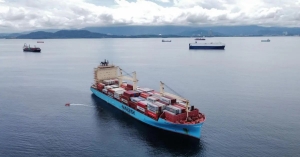
A.P. Moller-Maersk (Maersk) is launching a new 1.1 million square-feet distribution Centre in Jurong West to strengthen its Omni-channel-fulfilment capabilities in Singapore.
The World Gateway 2 inaugural ceremony was held on 19 July 2023, and it is expected to be completed in Q1 of 2025.
Strategically located in the industrial area with direct access to major highway, Ayer Rajah Expressway (AYE), the facility has convenient access to Tuas Mega Port and Changi International Airport.
It is also within close proximity to World Gateway 1, currently Singapore’s largest automated and customs bonded warehouse.
The new distribution Centre is designed to have a capacity of 30,000 pallet Automated Storage & Retrieval System (AS/RS), with a large floorplate of 160,000 square-feet.
This multi-story facility will have a high ceiling with 11-metre clear height per floor, suitable for dense storage and automation.
Equipped with ample loading bays and container parking places to manage peak season volumes, Maersk explained in a statement that the Centre will cater to the booming e-commerce fulfilment needs, as well as offering logistics solutions for different industries.
“Maersk’s World Gateway 2 regional distribution Centre will increase Singapore’s capacity and capabilities to support Omni channel fulfilment in Southeast Asia,” said Chairman of Singapore Economic Development Board, Png Cheong Boon.
“With extensive use of automation and robotics systems, it will be one of the most productive warehouses in Singapore and will also create many skilled and high value jobs in technology, digitalization, data analytics and e-commerce.”
This new facility will be both LEED Platinum – and Green Mark Platinum – certified for its outstanding design and performance in environmental aspects, Maersk reported.
It will be equipped with motion sensor-LED lights, solar panels, composite panel façade system for building insulation, and building management system for energy efficiency.
Dominic Gates, CEO of Omni channel-fulfilment, Maersk Asia Pacific, further stated: “Our powerful Omni channel-fulfilment solutions enable our customers to have predictability, visibility, and efficiency in their supply chain, improving their profitability and brand reputation in today’s complicated marketplace.
“Expanding the warehousing footprint and Omni channel-fulfilment competence is essential to our strategic growth, and we’re very excited about the opportunities that lie ahead.”
This announcement comes just over a week after Maersk announced the delivery of the world’s first containership powered by green methanol.
In the same week, Maersk announced its plans to implement an artificial intelligence (AI)-enabled robotic solution in its latest UK warehouse in East Midlands.
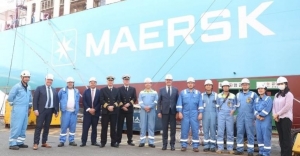
The 2,100-teu HMD Hull 4168, was built at Hyundai Mipo Dockyard Co. and Hyundai Heavy Industries Co. The vessel is set to embark on its maiden voyage towards Copenhagen where, in a ceremony, Ursula von der Leyen, the President of the European Commission will christen Maersk’s new feeder vessel.
“The introduction of this container vessel is a significant step towards realizing our commitment to becoming carbon neutral, and it marks the beginning of a new era in shipping, where we together can minimize greenhouse gas emissions and create a greener future,” Maersk said.
Maersk said the 21,500 km trip from Ulsan, South Korea to Copenhagen, Denmark, will provide real operational experience for Maersk seafarers handling the new engines and using methanol as fuel. The feeder will be followed by 18 large oceangoing vessels of 16,000-17,200 TEU capacity which are scheduled for delivery in 2024 and 2025.
Maersk has secured green methanol for the ship’s first trip in cooperation with the Dutch producer and distributor of hydrogen-based products OCI Global. The company OCI will provide ISCC-certified green bio-methanol to power the maiden voyage of the new build.
As part of its decarburization strategy, Maersk has also recently ordered six mid-sized container vessels at Yangzijiang Shipbuilding Group. The six 9,000 TEU vessels will all have dual-fuel engines able to operate on green methanol and fuel oil. The ships are projected for delivery in 2026 and 2027.
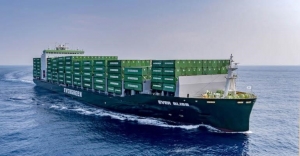
The order will be split in eight and 16 units between Japan’s Nihon Shipyard and South Korea’s Samsung Heavy Industries, respectively.
Vessel delivery dates are uncertain at the moment as the official contracts with shipyards had not been signed yet, according to Evergreen.
To date, Evergreen operates 214 vessels with a combined capacity of 1.676m TEU. The company is expecting to have two new vessels to be delivered this year and twenty-two to be delivered in 2024.
Methanol is increasingly the alternative fuel of choice for containership newbuilding.
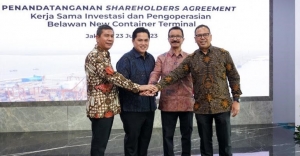
The strategic partnership between the Indonesia Investment Authority (INA), Indonesian government-owned port operator Pelindo, and DP World, will create Indonesia’s most direct link with the Malacca Strait, one of the world’s busiest shipping routes.
Sultan Ahmed Bin Sulayem, Group Chairman and CEO of DP World, Arif Suhartono, President Director of PT Pelabuhan Indonesia (Persero), and Ridha Wirakusumah, CEO of Indonesia Investment Authority, signed the agreement.
The agreement aims to increase BNCT’s capacity to 1.4m TEU, up from 600,000 TEU currently. BNCT will also aim to attract more direct calls, reducing North Sumatra’s reliance on regional hub ports to access regional and global markets.
The Malacca Strait region is served by three major transshipment hubs – Singapore, the Port of Tanjung Pelepas, and Port Klang, which feeder cargo to smaller ports across Southeast Asia such as Belawan in Indonesia.
The BNCT currently serves as a local hub for the neighboring provinces in Sumatra and the expansion and modernization programmed aims strengthen its position as a major trade and logistics gateway in the Malacca Strait.
Indonesia’s Minister of State-Owned Enterprises, Erick Thohir, stated that "As directed by President Joko Widodo, there is always strategic value for equity and acceleration of economic growth in the regions and nationally through port development, including this new container terminal at the Port of Belawan which is believed to support downstream to maximize exports in new ways and also accelerate the economy in North Sumatra which continues to grow. This is in accordance with the objectives of the Terminal port development which will strengthen the national port industry ecosystem, as well as the competitiveness of Indonesian ports as strategic trade routes in Southeast Asia and internationally."
"We are proud to help Indonesia expand the Belawan New Container Terminal and support its ambitions to develop the economy of Sumatra through infrastructure. By investing in cutting-edge sustainable technologies, world-class training and the highest standards of health and safety, we aim to eliminate inefficiency and enable the flow of trade between Indonesia and the world," said Sultan Ahmed Bin Sulayem, Group Chairman and CEO of DP World.
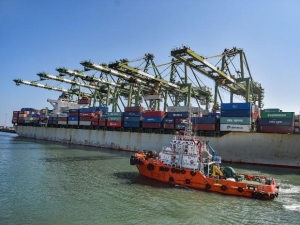
India and Russia are keen to make the Chennai -Vladivostok maritime route operational, and a stakeholder meeting to work out details have been scheduled in September, Union Minister for Ports, Shipping and Waterways Sarbananda Sonowal said.
The Vladivostok – Chennai route passes through the Sea of Japan, the South China Sea and Malacca Strait.
The proposed route is expected to take only 12 days, compared to the current route’s duration of 32 days. The new route would provide India with access to the Far East and open up opportunities for trade between the two countries.
The new route would provide India with access to the Far East and open up opportunities for trade between the two countries.
