










News
Latest news
More...
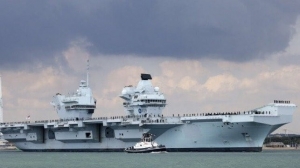
The Royal Navy has taken the unusual step of responding to media speculation by issuing a detailed statement on the damage to HMS Prince of Wales. One of the two largest ships of the fleet and only having recently been placed into service, the carrier suffered an embarrassing failure as she departed for what was being called a “landmark mission” in cooperation with the Americans.
Speaking in a videotaped statement, Rear Admiral Steve Moorhouse said, “Our focus has been on understanding the nature and extent of the damage and the safety of her crew. We will repair her and get her back on operations, protecting the nation and our allies, as soon as possible.”
HMS Prince of Wales departed Portsmouth on Saturday, August 27, for what was to be a nearly four-month program to sail to the United States for joint training exercises and a visit to the Caribbean. Observers noted as she departed that she seemed to only be showing a wake on the portside leading to rampant comments of a problem with possibly the starboard propeller.
Shortly after sailing, the carrier anchored with the Royal Navy admitting there had been an “issue” after her departure. She was later moved to a more sheltered position while a survey was ongoing.
“Royal Navy divers inspected the starboard shaft and adjacent areas,” says the Rear Admiral. “We can confirm there is significant damage to the shaft and the propeller and some superficial damage to the rudder. There is no damage to the rest of the ship.”
The initial assessment of the carrier also shows an “extremely unusual fault,” in the starboard shaft. The coupling that joins the final two sections of the shaft has failed.
According to the reports, the Royal Navy is currently trying to stabilize the situation before they can return the vessel to Portsmouth. They are also investigating repair alternatives, but are admitting that it is likely the Prince of Wales will need to dry dock to undertake repairs. No estimates were offered on how long it might take to complete the repairs.
In an effort to save the mission, the Royal Navy reports that they have reassigned HMS Queen Elizabeth to undertake a portion of the training exercise with the United States. The first carrier of the class is due to stand in for her younger sister ship departing this week for the United States. However, she will return to Europe earlier than planned to undertake her fall exercises which were scheduled for the Mediterranean.
So far, the Royal Navy has not offered any explanations as to how the damage occurred to the Prince of Wales. It is just the latest in a series of high-profile failures of the multi-billion-dollar carrier. Commissioned in December 2019, she spent most of 2020 and 2021 sidelined with a series of problems. Finally, in October 2021, the Royal Navy declared that she was fully operational and would be fully ready for frontline deployment by 2023.

Due to the increase in annual loading and unloading capacity of Chabahar port, this port offers great investment opportunities, said the Director General of Ports and Maritime of Sistan and Baluchestan
Regarding investments in Chabahar port, Behrouz Aghaei added that 12 companies have invested in Chabahar port and 11 investment contracts are being signed. Considering this, it is expected that by the end of this year significant investments will be made in this port.
Aghaei continued: The foreign and domestic investors have chosen the port of Chabahar as their investment destination, and in recent years we have witnessed an increasing number of investors in this port. Due to the increase in annual loading and unloading capacity of Chabahar port to eight million tons in the first phase of the Shahid Beheshti Port Development Project, this port offers good investment opportunities.
The port of Chabahar, as the largest oceanic port of the country, has great potential in terms of land and sea, due to its location outside the Persian Gulf; it can play a significant role in increasing the level of maritime trade in the country.
Reference: Pmo.ir
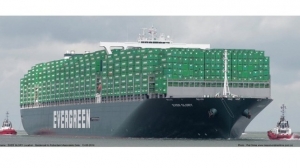
Currently several means of transport and workboats are undergoing accelerated development towards automation and automated movement.
Almost daily publications appear about automation in shipping. Names of large maritime industrial companies are often found in these publications, giving the idea that they are a major driving force behind these developments.
The question can and should be asked, how realistic are these developments? Are they generally applicable, applicable for certain sectors or trades, or perhaps not applicable at all?
In the recently published book Tug Use in Port. A practical Guide, attention has been paid to future autonomous or remote controlled tugs. As a sequel to this specific item, a recently published report has addressed the question: How will tugs and tug assistance evolve in the coming 30 years? What are the factors of influence? Is it just the important issue of automation, or are there also other factors that will play a role and have to be taken into account? The answer is “Yes.” See, therefore, the full report here. It is also these factors that are addressed in this article. They should be regarded in combination with the continuing automation processes on board ships and tugs.
Some basic situations to keep in mind:
• At present and also in the coming decades, there is hardly any uniformity in ships and this applies to a great extent to tugs as well.
• Worldwide, future developments will differ greatly by country, port, shipping and towing company. This particularly applies to the way automation progresses on board ships and tugs.
• The major components - ships, ports, tugs, pilots - of the maritime transport chain interfere. This means for instance that an increase in ship size or in its maneuvering capabilities has its effect on ports, pilots and tugs, just as a change in port layout or infrastructure has its effect on ships, pilots and tugs.
• Finally, the developments that will be discussed below can all be disturbed by trade wars, political conflicts, climate changes, etc.
Now the important factors that are expected to play a role in the coming 30 years and will have its effect on ports, port services like tugs and tug assistance:
Seaborne trade will increase. UNCTAD expects that seaborne trade will triple by 2050 compared to 2016. DNV GL estimates a lower growth of approximately the half. Even then it will have a large effect on ports and port services, like tugs.
Proportional changes in type of cargoes. According to DNV GL's Energy Transition Outlook 2018 the world needs less energy from the 2030s onwards owing to rapid gains in energy efficiency. DNV GL forecasts that the primary energy supply peaks in 2032 while oil demand peaks in the 2020s and then decreases. Natural gas takes over as the biggest energy source in 2026. This includes a decrease of crude oil and other oil products to be transported after 2020 and an increase of natural gas. This will affect the infrastructure of ports and increase the number of offshore terminals and will consequently affect tugs and tug assistance.
Means of sea transport changes. The size of certain type of ships may further increase, e.g. container ships and gas carriers. In addition, new methods of sea transport may be developed and certainly all the activities at sea will introduce new design features for new ship types. Also other transport systems may take over. For instance, underwater transport may become reality or transport by pipelines, having its effect on conventional sea trade and ports. Tugs should keep pace with these developments.
The maneuvering capabilities of large ships, e.g. container vessel, ferries and cruise vessels, are expected to increase, reducing the need for tug assistance. It should however be said that even the most automated ships, such as remote controlled or autonomous ships, will still experience engine or steering failures as is the case with present ships, although possibly in a lower degree. If this happens at sea along the coast and such problems cannot be resolved in time, specific assistance of emergency towing vessels or suitable harbor tugs will be needed for such ships.
Tug assistance in adverse weather situations. There is another aspect which concerns in particular future ships with increased maneuvering capabilities in restricted waters. The situation may arise that when environmental conditions become such, for instance very strong winds, even these ships which normally would not use any tugs, have to use tugs to keep the ship under control. Consequently, there will always be a need for a sufficient number and power of tugs to be available.
Some more factors of importance:
• On a wider level, it is envisaged that the exploitation of the seas and oceans will increase which will bring more vessel movements and changes in the activities in and near ports.
• The growing size of ships and high safety requirements may further result in a need for tugs to make fast outside the breakwaters in wave conditions, and also because of the risks involved future developments may include more gas terminals located offshore and away from residential areas.
• Ports and transshipment areas moving into more exposed conditions could be a long term development, further supported by increasing offshore activities, offshore terminals and perhaps offshore (floating) ports with less possibilities of building long protective breakwaters.
It can therefore be concluded that ship handling in exposed conditions will continue to grow in importance, consequently tugs should be designed and equipped to be able to operate in these conditions.
During the coming decades a large variety in ships will be seen as indicated above, from well equipped vessels with a large degree of automation to, let us say, rather conventional ships. These conventional ships will still need tug assistance. In addition, it should not be forgotten that in many ports tugs have to do more than just handling seagoing vessels, as is explained in the book Tug Use in Port.
So, apart from the developments in the field of automation on board ships and tugs, other important developments are expected in the coming decades that will affect ports and port services such as tugs and tug assistance. All these developments result in high additional demands on tugs, tug crews and tug assistance. It is therefore of utmost importance that capabilities of tugs and tug crews keep pace and meet the requirements set by these future developments. At the same time the progress of automation on board tugs and ships may help to create tugs being fit for the future.
The large-format hardback book Tug Use in Port is illustrated with a wealth of detailed diagrams, graphics and photographs. The book can be ordered at a price of €45 at The ABR Company Limited
By:Henk Hensen
www.tugandosv.com.
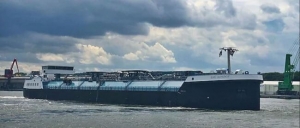
Europe’s first inland-waterway liquefied natural gas (LNG) bunker vessel has performed her first bunkering operations, with the Containerships Polar and Containerships Nord vessels, in Rotterdam, the Netherlands. The LNG London (which is owned by LNG Shipping – cooperation between Victrol and Sogestran) is on long-term charter to Shell. It will primarily be used by Shell for LNG bunkering in the ports of Amsterdam, Rotterdam and Antwerp.
“The entry into service of LNG London shows our ability and commitment to providing safe and reliable supplies that help meet the growing need for cleaner-burning fuel,” Tahir Faruqui, General Manager, Shell Global Downstream LNG, said. “We are pleased to have three LNG bunker vessels in our fleet and look forward to others joining them in the future.”
Gisèle Buelens, CEO of Victrol, said: “In 2017, Shell selected us to build an inland LNG bunker vessel. As pioneers in bunker vessels, we designed a completely new vessel that complies with the latest safety and operational requirements. We are pleased that she has completed her first operation and that many more LNG bunkering operations will take place in the years ahead.”
Pascal Girardet, CEO of Sogestran, said: “We are very proud of LNG London, the first inland LNG bunkering ship in Europe. The inland capability offers clear logistical benefits for end users, benefits that will help drive the growth of LNG as a cleaner marine fuel.”
LNG London will be loaded with LNG at the Gate terminal in Rotterdam. An innovative transfer system enables the delivery of LNG to seagoing vessels, inland barges and terminals onshore, while a restricted air draft allows the barge to sail via inland waterways to Antwerp and Amsterdam if required.
When compared to traditional marine fuels, natural gas significantly reduces NOx and reduces overall GHG emissions by up to 21%, according to a “well-to-wake” emissions study by Thinkstep. Given the International Maritime Organization’s 0.5% sulphur cap implementation by 2020, there is an increasing interest from the international marine community to consider LNG as a marine fuel.
Reference: shell.com
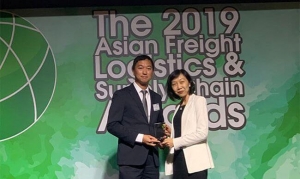
MSC is proud to have won the Best Shipping Line: Asia – Africa category at the prestigious Asian Freight, Logistics and Supply Chain (AFLAS) Awards, underlining the company’s strong position in the region.
MSC has responded to growing demand by increasing services between Asia and Africa, reducing transit times and providing more efficiency and ease of access for customers. We are honoured and grateful for the endorsement by Asia Cargo News readers, among them many shipping line service users.
The awards are hosted and organized annually by Asia Cargo News to recognise leading logistics and supply chain providers, based on excellence in customer service, innovation and quality of service. This year, they were announced on 17 June at a Gala Dinner and Award Ceremony, held at The Asia Society Hong Kong Centre.
The nomination and voting process allowed the more than 15,000 readers and e-news subscribers to first determine the leading companies in the market, and then determine the winners, making the results the opinion of service users rather than a panel of judges.
Reference: msc.com
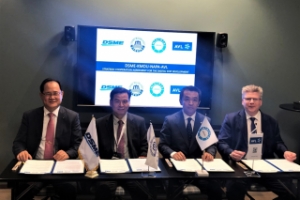
Daewoo Shipbuilding and Marine Engineering (DSME), Korea Maritime and Ocean University (KMOU), NAPA and AVL have signed a strategic cooperation agreement to develop digital ships and related strategic solutions.
The deal was signed at Nor-Shipping 2019 exhibition in Oslo held from June 4 to 7.
As explained, the agreement will combine the four parties’ expertise in naval architecture and shipbuilding, engines, big data, and software development to pioneer new solutions that combine all of these elements for the first time.
Specifically, the collaboration will cover all aspects of creating comprehensive digital twins — from the acquisition and processing of quality engine room data, ship performance and meteorological data to the training, simulation and human machine interface that will be necessary to turn insights from engine data into practical efficiencies.
“The development of digital twin ship and engine is one of the most exciting outcomes of the recent surge in maritime digitalization and development of the Internet of Things. By creating a virtual, real-time copy of engine equipment, we can better monitor, analyze, and predict performance, leading to safer and more efficient operations,” Odin Kwon, CTO of DSME, commented.
“Digital twins bring together a range of different fields of expertise, requiring hardware, software and operations to work together. This is why collaboration is essential if this technology is to mature… We’re excited to work together to develop digital twin technology and a platform that will make future generations of ships safer and smarter,” Kwon added.
“We are actively entering into digital era in the industry nowadays which could be a basis for the development of autonomous ship. Building a digital platform should be well balanced between actual application of technology and academic basis,” Professor Deog Hee Doh from KMOU said.
He further said that KMOU faculty members have started developing a platform in which AR/VR and digital twin technology are embedded. According to the professor, the university will focus on providing a knowledge-based platform in the fields of simulations and communications related to digital ships extending to AR/VR.
“New generations of vessels will set the standard for decades to come, and digital infrastructure will be just as important as the physical and mechanical elements of a newbuild,” Naoki Mizutani, Executive Vice President, Shipping Solutions at NAPA, noted.
Each partner brings a different angle to the collaboration, coordinated by DSME. NAPA will develop digital twin ship models with digitalized components and a real-time simulation platform to integrate between engine models and ship models.
Meanwhile, AVL will develop the simulation tools and methodologies that the partnership projects will require.
Additionally, KMOU will contribute by providing the existing infrastructure as a basis for further development and optimization.
Reference: worldmaritimenews.com
